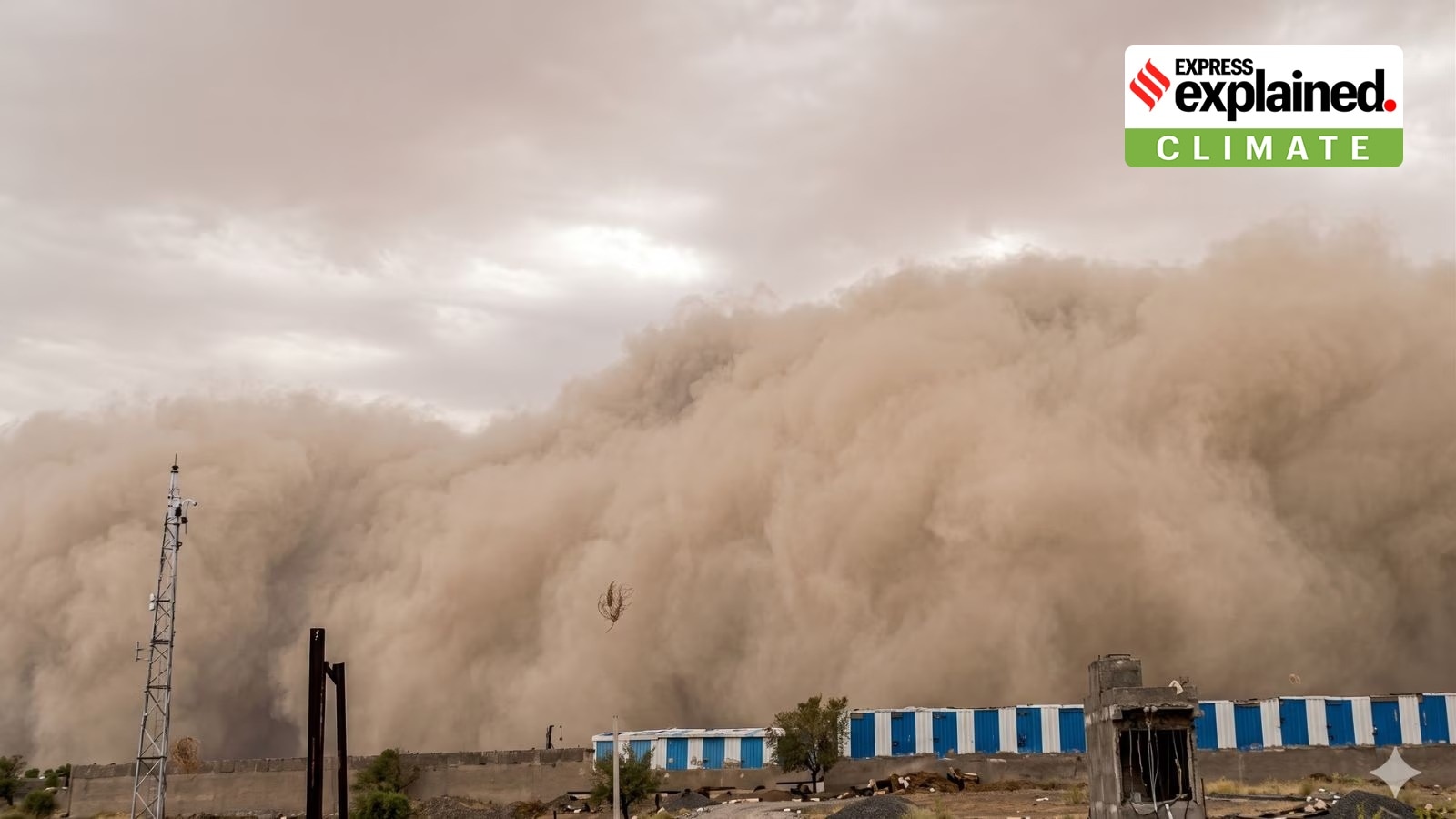
 The dust storm in Churu on May 30. (Screengrab PTI/Enhanced with Gemini)
Visuals of a massive dust storm in Churu on Saturday (May 30) have been going viral on social media. The storm, which affected Churu, Hanumangarh, Sri Ganganagar, Bikaner, Nagaur, Didwana-Kuchaman, Alwar and Sikar, is common in parts of Rajasthan this time of the year, when dust-bearing winds blow in from the Middle East and the Thar Desert.
What stands between the Thar’s dust and the densely populated Indo-Gangetic plains is the Aravalli range. As the winds run into the Aravallis, they lose speed and drop their load of sand. Many such sand dunes, called ‘obstacle dunes’, can be found on the range’s slopes, visual proof of the protective role it plays.

PTI SHORTS | Massive dust storm sweeps through Rajasthan’s Churu, disrupting normal life
WATCH: https://t.co/T7QmfNyVcd
Subscribe to PTI’s YouTube channel for in-depth reports, exclusive interviews, and special visual stories that take you beyond the headlines. #PTIVideos
— Press Trust of India (@PTI_News) May 30, 2026
As Chetan Agarwal, environmental researcher and Senior Fellow at the Centre for Ecology Development and Research (CEDAR), explained, “On many hills on the western slope, directly exposed to the hot winds from the west, there are large deposits of sand known as obstacle dunes. The vegetation growing in these dunes is similar to that found in desert regions. If there is additional tree cover, the wind has to pass through it, creating a natural scrubbing effect and reducing the movement of sand and dust. The dunes clearly show the role the Aravalli range plays in interception of dust.”
This shield, however, is under stress, as the range degrades due to loss of vegetation and mining on hillocks. Meteorologists say dust from Rajasthan reaches the northern plains now even when a dust storm is not very intense.
Dust storms and the Indo-Gangetic plains
Dust storms primarily originating from the Thar Desert are not unusual over northern India in the pre-monsoon months of April to June. These storms are fuelled by intense heat and dry conditions, while south-westerly and westerly winds move the dust across the region.
The India Meteorological Department’s (IMD) Climate Hazards and Vulnerability Atlas of India, based on 1981-2010 climatological normals, shows that parts of northwest India fall in the highest dust-storm frequency class, averaging 0.89 to 1.55 dust-storm days.
The long-period data shows that Delhi and its neighbouring districts already lie in a high-exposure zone. In June, the storm activity is markedly high, with the national capital district recording a frequency of 2.5 days, the highest in the country for the month. With the Aravalli’s degradation, the effects of such storms can be felt more.
“Nowadays, whenever wind speed reaches 35 to 40 kmph, dust from Rajasthan is being carried up to the northern plains, which was not the case earlier. Usually, dust particles were carried when an intense dust storm originated over Rajasthan and travelled towards Delhi,” said Mahesh Palawat, vice president of Meteorology & Climate Change at Skymet Weather Services Pvt. Ltd.
State of the Aravalli range
A Forest Survey of India (FSI) assessment of 2018 found that 31 of the 128 Aravalli hills in Rajasthan had disappeared due to anthropogenic pressures. There has also been a loss of hills with 200 meters to 600 meters elevation above sea level in Naraina, Kalwar, Kotputli, Jhalana, and Sariska in Rajasthan.
The Environment Ministry in its Aravalli restoration framework last year flagged the causes behind the degradation to be a mix of mining of red silica, granite and other minor minerals, deforestation, urbanisation, construction activities, land-use change, pastoral activities and encroachments.
A 2009 study by the Wildlife Institute of India (WII), which is still heavily cited by researchers and officials, had identified 12 gaps in the Aravalli range that have expanded due to forest degradation and inadequate cover.
These growing openings not only threaten to increase the frequency of sand and dust storms in surrounding regions including Delhi, Punjab, and Uttar Pradesh — and further deteriorating Delhi’s air quality — but impact rainfall as well.
Exposure to regular dust carrying winds or dust storms can also alter the amount of sunlight reaching the ground, affecting surface temperatures over large areas. In effect, dust can impact the scattering of sunlight and temporarily bring down temperatures.
Hiren Jethva, a senior scientist at NASA, told The Indian Express, “The effect of Aravallis degradation and dust transport over Northern India requires long-term investigation and analysis on dust frequency and load over northern India.”
