 Odysseus’ voyage takes him across an imagined Mediterranean where real places coexist with mythical landscapes.
Christopher Nolan’s adaptation of The Odyssey arrives in cinemas on July 17, introducing one of the oldest surviving works of Western literature to a new generation of viewers.
Despite its enduring influence, many readers and filmgoers know The Odyssey more by reputation than by its story. Written nearly 3,000 years ago, it is a story of homecoming after war, set in a world populated by gods, monsters and mortals. Its themes, characters and adventures have influenced storytelling ever since. Even those who have never opened the poem are likely to recognise its enduring influence, from the Cyclops and the Sirens to the image of the Trojan Horse.

Whether you’re coming to Homer for the first time or simply wondering how Nolan’s film fits into the ancient epic, here’s where to begin.
What is The Odyssey?
One of the foundational works of Western literature, The Odyssey is one of two epic poems traditionally attributed to the Greek poet Homer, and generally dated to the eighth century BCE.
Today, “epic” is often used to describe something monumental. In literature, however, an epic is a long narrative poem that typically deals with extraordinary figures, heroic deeds and the intervention of gods or other supernatural forces.
Both the Iliad and The Odyssey have sparked debate about their authorship, triggering what is known as the Homeric Question. Scholars continue to debate whether Homer was a historical individual, a name attached to an oral poetic tradition, or some combination of both.
How does the film differ from the poem?
The Iliad and The Odyssey are companion epics set within the same mythic tradition. While the Iliad recounts a brief episode during the Trojan War, The Odyssey follows Odysseus’ decade-long journey home after the war has ended. It is often cited as one of literature’s earliest and most influential “hero’s journeys”.
While the poem The Odyssey begins after the events of Troy, the film reportedly begins with the episode of the Trojan Horse, in which Odysseus devises the ruse by which the Trojans bring the giant wooden horse within their city walls, which they believe to be an offering to Athena.
The Associated Press reported that the film also includes elements from related stories such as Virgil’s poem, The Aeneid, and the play Agamemnon, a Greek tragedy by Aeschylus. The film thus appears to draw on the wider Trojan tradition, not a page-for-page adaptation of Homer’s poem.
The setting
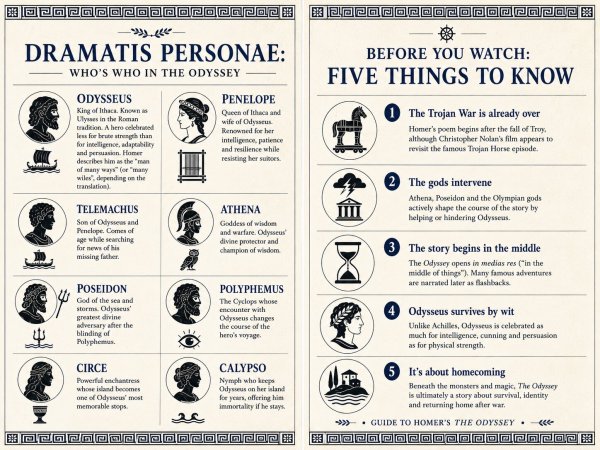 Graphic generated by ChatGPT
The poem famously opens in medias res (in the middle of things) – neither at the start of the Trojan War nor at the start of Odysseus’ journey home but in the middle of his journey. The hero is stranded on the island of Calypso, a goddess-nymph who wishes to make him her husband for all eternity.
Back in Ithaca, his wife, Penelope, is staving off suitors in Ithaca who have taken over the king’s palace. Classical scholar Emily Wilson, in her 2018 translation of The Odyssey by Homer, draws a parallel with the way Helen of Troy’s suitors threatened to steal a married woman from her marital house, as though she were a bride. Penelope is not merely a passive figure waiting for her husband to return. Her endurance, intelligence and ability to navigate the pressures of the suitors make her one of the poem’s central characters. Wilson notes that Penelope’s motivations remain ambiguous throughout the narrative, a complexity that Nolan also highlighted in an interview with The Associated Press.
At the same time, Telemachus, their son who was an infant when Odysseus went to battle, has grown up and is about to commence a quest of his own that will take him far from home.
The Odyssey is set in a world in which reality and mythology are heavily intertwined. In this world, gods are willing and active participants in the events that transpire. The film appears to nod at this, with the trailer suggesting a “time of apparent magic”. Divine intervention is a driving force in the poem.
Wilson writes, “The gods in The Odyssey, like those of The Iliad, are self-interested beings, whose interventions in human lives are motivated by their own desires, whims and preferences rather than by a consistent commitment to uphold moral law”.
This is best exemplified by Athena, the Greek goddess of wisdom and warfare, who readily appears before Odysseus at several junctures to help his journey. Wilson suggests that Athena does not favour Odysseus because he is morally superior. Rather, she admires his intelligence and resourcefulness, qualities that distinguish him from other mortals.
If Athena is Odysseus’ protector, Poseidon is his greatest divine adversary. After Odysseus blinds Polyphemus, one of the Cyclopes, his father, Poseidon, the Greek god of the sea and storms, unleashes his wrath on the hero. Over the next ten years, Poseidon subjects Odysseus to brutal storms and shipwrecks that delay his return home.
A journey across the ancient Mediterranean
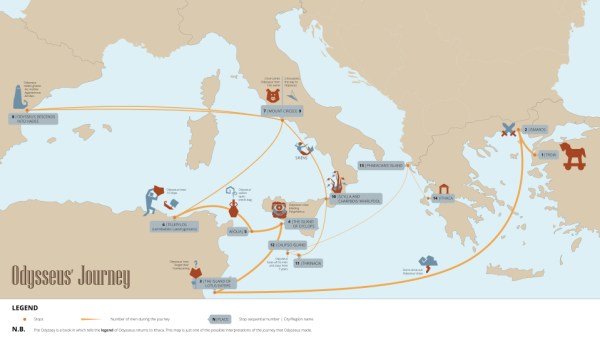 Odysseus’ journey (Wikimedia Commons)
Odysseus’ voyage takes him across an imagined Mediterranean where real places coexist with mythical landscapes. While Troy and Ithaca correspond to real locations in Turkey and Greece, many of the places associated with Calypso, Circe and the Cyclopes belong to legend or remain the subject of scholarly debate. The accompanying map shows the traditional route attributed to The Odyssey.
The relevance of the poem
Wilson notes that the story being recounted in this poem is “small and ordinary”, that of “a man” who is “not ‘the’ man, but one of many men — albeit a man of extraordinary cognitive, psychological and military power”. She also notes that, contrary to the reader’s expectation of what we conventionally understand as an “epic” narrative, The Odyssey recounts “the story of a man whose grand adventure is simply to go back to his own home, where he tries to turn everything back to the way it was before he went away. For this hero, mere survival is the most amazing feat of all.”