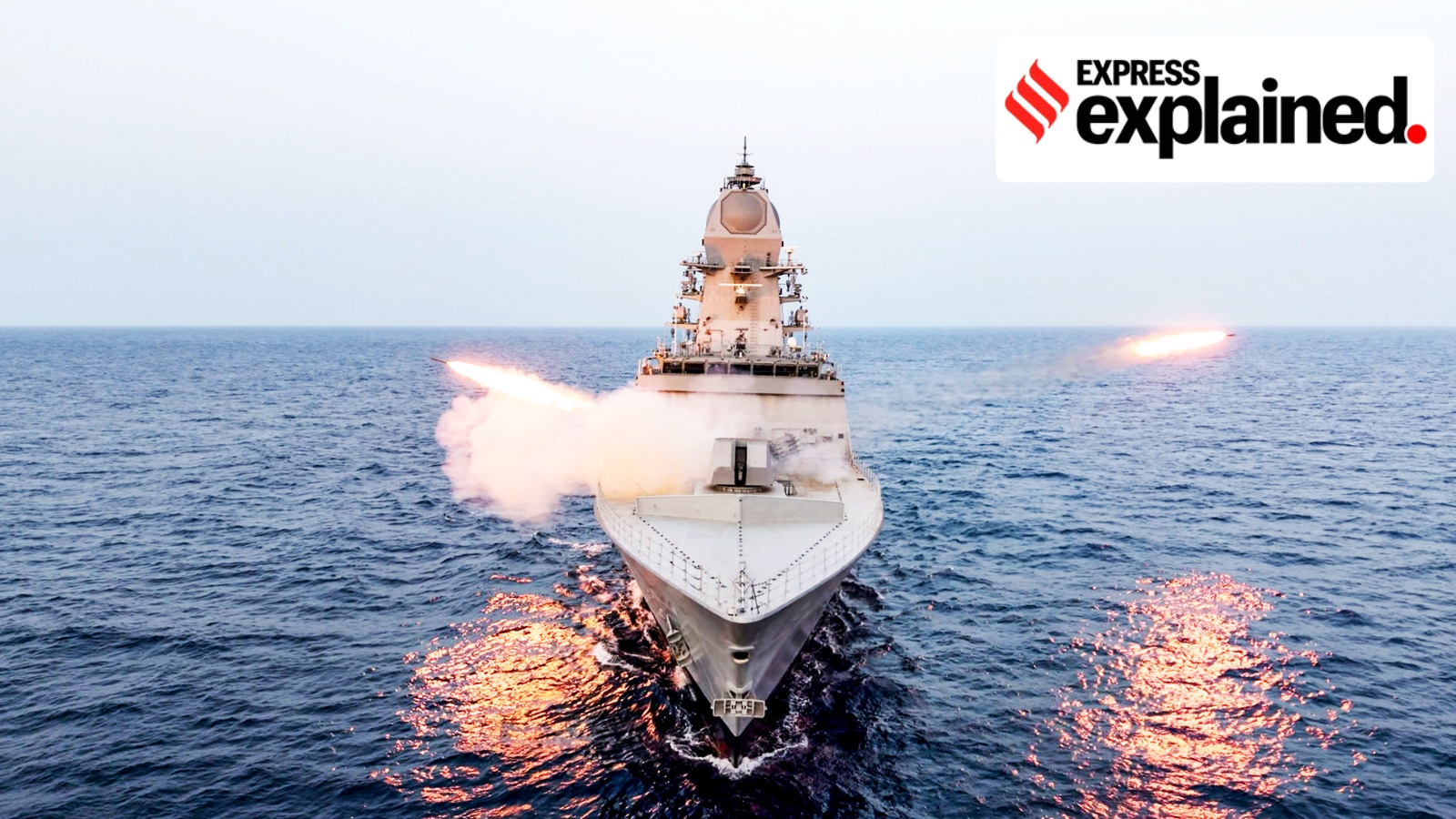
 INS Mahendragiri during its commissioning ceremony, in Visakhapatnam, Andhra Pradesh. (PIB via PTI Photo)
The Indian Navy on Saturday (July 11) inducted the indigenously built advanced stealth frigate INS Mahendragiri into its Eastern Fleet during a ceremony held in Visakhapatnam.
Navy Chief Admiral Krishna Swaminathan described the warship as a symbol of India’s growing maritime capability and technological self-reliance. The commissioning is particularly significant as it marks the induction of the sixth indigenous stealth frigate from the Navy’s Project 17A into the force within just one-and-a-half years.

Since January 2025, six of the seven Project 17A frigates have been commissioned, including INS Mahendragiri. The seventh and last of them, INS Vindhyagiri, is also expected to be commissioned this year.
What is INS Mahendragiri?
INS Mahendragiri is built with over 75% indigenous content, has a displacement of approximately 6,670 tonnes and the capability to reach speeds of up to 28 knots.
It is equipped with the BrahMos supersonic surface-to-surface missiles, a combination of multifunction radar and medium-range surface-to-air missiles, which can detect and kill aerial threats at extended ranges.
It also boasts anti-submarine warfare capabilities, with its arsenal including an indigenous rocket launcher, torpedo launchers, an Integrated Anti-Submarine Defence System, an Electronic Warfare suite and a Close-In Weapon System for short-range threats, and an embarked multi-role helicopter.
The warship has advanced stealth features, modern sensors, network-centric combat systems and state-of-the-art weapon suites.
“All these capabilities make the warship formidable and resilient,” Defence Minister Rajnath Singh said at the commissioning ceremony. The warship is named after the Mahendragiri mountain range in the Eastern Ghats and was built with the contribution of more than 200 Indian industries, including numerous Micro, Small and Medium Enterprises (MSMEs).
And what is Project 17A?
Project 17A frigates are versatile multi-mission platforms designed to address current and future challenges in the maritime domain, including threats from adversarial submarines in the deep sea. They have been designed by Warship Design Bureau (WDB) and overseen by Warship Overseeing Team (Kolkata).
According to the Navy, the frigates reflect a generational leap in indigenous ship design, stealth, survivability, and combat capability. The warships are fitted with an advanced weapons and sensor suite compared to the earlier Project 17 (Shivalik) class. These ships are configured with Combined Diesel or Gas (CODOG) propulsion plants, comprising a diesel engine and a gas turbine that drive a Controllable Pitch Propeller (CPP) on each shaft, and an Integrated Platform Management System (IPMS).
The weapons and sensors suite also comprises advanced naval radar system MF-STAR (Multi-Function Surveillance, Track And Guidance Radar) and Medium Range Surface to Air Missile complex, 76mm Super Rapid Gun Mount (SRGM), and a combination of 30 mm and 12.7 mm close-in weapon systems.
What has driven the quick commissioning?
The learnings from constructing the first four P17A ships have enabled compression of the construction timeline for the next three ships.
With INS Nilgiri getting commissioned in January 2025 as the first of the warships, INS Udaygiri and INS Himgiri followed in August. INS Taragiri was commissioned in April this year, INS Dunagiri last month and INS Mahendragiri on Saturday.
From December 2024 to date, the Indian Navy has commissioned 18 warships, showcasing India’s growing prowess in indigenous shipbuilding. By the end of this year, eight more ships are expected to be commissioned, according to the Navy.
Officials told The Indian Express that the successful progress of naval projects is due to several factors at both the planning and execution stages. It is understood that the Navy received a considerable number of Acceptances of Necessity (AoNs), or clearances to procure platforms, from the Defence Acquisition Council.
Headed by the Defence Minister and with the Chief of Defence Staff, Army Staff, Naval Staff and Air Staff (CAS) among its members, the body gives in-principle approvals for capital acquisitions. Based on its approvals, the Indian Navy commenced design and construction processes on time for several projects, including Project 17A and Project 15 B ships (or Vishakhapatnam-class, the latest class of indigenous guided-missile stealth destroyers that includes four ships built by Mazagaon Dock Shipbuilders). Other works include the Survey Vessel (Large) and the ASW Shallow Water Craft (ASW-SWC) project.
With multiple AoNs in hand and timely contract signings, construction also began well within the projected timelines, leading to timely delivery and commissioning of several ships in the last few years. There are currently 48 warships under construction.
Additionally, plans are underway for constructing next-generation destroyers. A dedicated team from the Navy is involved throughout the entire process of constructing the ships, from inception to delivery. This enhances coordination and engagement between the Navy and the shipyard at all stages, including during the design and integration phases.
Another key factor contributing to the rapid commissioning is the continuous evolution of newer technologies and the modular construction of ships. Additionally, the use of advanced simulation models during the design process allows for greater accuracy and multiple rounds of refinement. Public-private partnerships for major projects have also helped compress delivery timelines from 90 months to 72 months.

