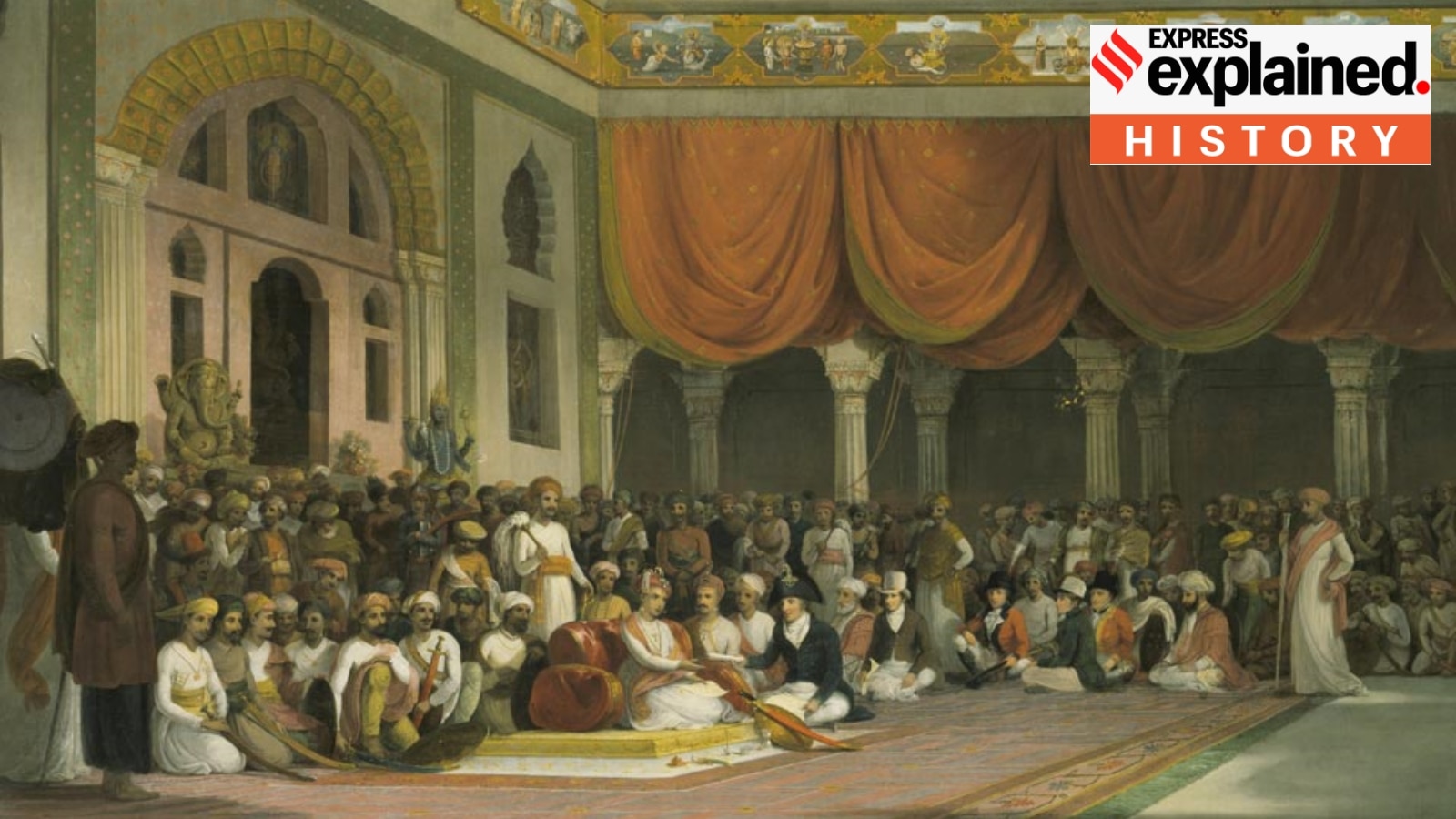
 Peshwa Madhavrao II in his court in 1790, concluding a treaty with the British. According to history researcher Indrajit Sawant, the Marathas effectively decided who would sit on the Mughal throne in Delhi during the 18th century. Photo: Wikimedia Commons
Earlier this month, a PIL petition was filed in the Bombay High Court challenging the removal of the “Maratha Empire” map from the revised Class 8 NCERT Social Science textbook, Exploring Society: India and Beyond – Part 1. The petition alleges that the National Council of Educational Research and Training (NCERT) acted arbitrarily and under political pressure from groups in Rajasthan, without relying on historical evidence or expert consultation.
The group of petitioners, which includes descendants of prominent Maratha-era families, social workers, and others, have sought restoration of the map across all language editions, alleging violations of constitutional rights.

Here’s what to know about the controversy that erupted last year, the current case, and the contested history of the Maratha empire’s control over parts of Rajasthan in the 18th century.
The controversy
In the revised Class 8 NCERT Social Science textbook released in July 2025, a map showing the extent of the Maratha empire in 1759 courted controversy, after a member of the royal family of the erstwhile princely state of Jaisalmer had called the map “historically misleading, factually baseless, and deeply objectionable”.
The map showed Jaisalmer to be a part of the Maratha empire. It also showed parts of the western coast and a large part of the northern plains and present-day Gujarat, Rajasthan, Lahore, and Peshawar under the Marathas. The revised Class 8 textbook also included a separate chapter on the Marathas.
Under the old curriculum, the Class 7 History textbook had a section on the Marathas as part of a chapter on 18th-century political formations. That chapter had two maps indicating state formations during that period. While it did not mark specific boundaries, it placed the Marathas in the region of present-day Maharashtra, with arrows pointing outward to indicate their expansion, and the Rajputs around present-day Rajasthan.
NCERT later clarified that the map under scrutiny included areas under direct Maratha control, as well as tributary states and regions under temporary agreements or influence. The clarification stated that the disclaimer about approximate borders (present in the Class 7 textbook) should also have been included in Class 8.
On August 11, 2025, NCERT formed a high-powered committee of experts in response to protests from Rajasthan’s royal families and politicians.
The petition in Bombay HC
The PIL petition in the Bombay High Court states that although the committee had initially acknowledged the matter as “controversial and complex”, it subsequently decided to remove or withdraw the map from the Hindi edition “without examining a single historical record.”
It added that in September 2025, Gajanan Bhaskar Mehendale, a panel member, passed away, leaving the committee incomplete. Mehendale was a historian noted for his scholarship on Maratha history. The petitioners claimed the panel continued proceedings without filling Mehendale’s vacancy with a history specialist.
Between October last year and April 2026, the petition claimed, NCERT “quietly and without any public announcement” removed the map from all editions, and in March 2026, the Maharashtra Government wrote to the Centre seeking restoration of the map.
Mudhojiraje Bhonsle, one of the petitioners, alleged that NCERT removed the map solely following objections raised by royal families in Rajasthan. “The map should not have been removed as there is sufficient historical evidence supporting it,” he told The Indian Express. He further alleged that after Mehendale’s death, no historian from Maharashtra was appointed to NCERT, and the decision was taken without consulting any historian from the state.
Calling the “Attock to Cuttack” map — a historical phrase describing the vast extent of the Maratha Empire at its peak in the mid-18th century, stretching from Attock on the Indus River (now in Pakistan) to Cuttack in Odisha (eastern India) — a representation of “Hindavi Swarajya”, he said the petitioners had submitted documents including references from the “Rajputana Gazette”, Mughal-era agreements and British records from 1822, which they claim establish Maratha influence over Rajasthan.
According to Bhonsle, a member of the erstwhile Nagpur royal family, NCERT had admitted through RTI responses that it had no evidence proving the map was incorrect. Calling the decision “one-sided”, he said “history should not be altered under pressure”.
Bhonsle also pointed to ample historical evidence of Maratha influence in Rajasthan, including the collection of “chauth” (which means accepting the overlordship). He argued that if objections reject Maratha influence in Rajasthan, then Mughal and British rule over the region would also have to be denied.
The petitioners, however, have argued that historical records show Jaisalmer did not pay tribute to the Marathas not because it was independent, but simply because it was geographically far from the areas where the Marathas and the Pathans operated. They cited British-era documents stating that Jaisalmer’s remoteness was the reason no tribute was collected.
According to the petition, Jaisalmer was also politically and militarily weak at the time, facing territorial losses, internal instability, and very limited military strength. The petitioners further argued that when the British signed a treaty with Jaisalmer in 1818, they continued the same arrangement of not imposing tribute due to the region’s remoteness, which they claim shows continuity between the Maratha and later British administrative systems.
Contested histories
History researcher Indrajit Sawant told The Indian Express that following the death of Mughal emperor Aurangzeb in 1707, the Marathas launched campaigns across India to dismantle Mughal rule. For nearly a century, the Marathas effectively decided who would sit on the Mughal throne in Delhi.
Sawant said that in the 18th century, the Marathas established unquestioned authority from Attock to Cuttack, from the Gulf of Khambhat to beyond the Kaveri river. This included the Rajputana region of present-day Rajasthan, which was then divided into Rajput states.
According to him, Rajput rulers from Jodhpur, Jaipur and Udaipur accepted Maratha overlordship and maintained alliances with them. He said that authentic records also show that these rulers paid tribute or chauth to the Marathas, what he termed “effectively protection money”.
Sawant said that renowned historians and researchers have produced maps documenting this period, and such maps have long appeared in history books worldwide. He cited the historian G S Sardesai, who documented the Maratha Empire in Marathi Riyasat Part IV: Balaji Bajirao Peshwa. Sardesai’s map includes not only Rajputana but also Attock and Peshawar in present-day Pakistan, and his research was recognised by the British government, giving his work historical reference value. Another example Sawant mentioned was Maps of India 1795–1935, published by the Maharashtra State Archives, wherein a detailed 1795 map depicts the spread of the Maratha Empire across India, including Rajputana.
Sawant pointed out that Rajputana has long been shown as part of the Mughal Empire in historical maps without any objections, and said: “Then why object to Maratha rule?” He added that historical evidence of Maratha influence should be acknowledged and taught just as other dynasties, and called for restoration of the map and a neutral NCERT panel to review the issue.
When the controversy over the map erupted last year, Rahul Magar, assistant professor of history at Savitribai Phule Pune University, had told The Indian Express that “Marathas were collecting chauth and sardeshmukhi (a form of tax) from the Rajput territories, but does that mean that they had political intervention in those states? No, they did not, in many cases.”
He added that economic tribute and political authority should be treated as distinct: “These states, like Rajputana and even Orissa and Bengal, were paying financial tribute, but it is not necessary that they politically considered the Peshwa as their overlord.”
Dilbagh Singh, retired professor of history at Jawaharlal Nehru University, told The Indian Express last year that the Marathas raided parts of Rajasthan a number of times to claim tribute, adding that while the Marathas did take control of some territory, no Rajput state was ever annexed to be “directly ruled by the Marathas”. According to him, the Marathas did not raid Jaisalmer and Bikaner and that most of their attacks were confined to Jaipur and Jodhpur.
