 Due to Mumbai's close proximity to the sea, the salinity levels of the underground water is high, making them unfit for extraction for potable usage. Photo: Wikimedia Commons
Earlier this week, the Brihanmumbai Municipal Corporation (BMC) announced that a 10% water cut will be imposed starting Friday (May 15). Mumbai is considered India’s financial capital, and the BMC is the country’s richest civic body.
According to the budget for the financial year 2026-27, the BMC’s water supply project and the hydraulics engineering department — which are responsible for supplying water to the city and creating the infrastructure — have a budget of Rs 6,475 crore and Rs 1,330 crore respectively. Despite the sizeable allocation of funds, Mumbai still has to depend on rainfall entirely for its source of potable water supply stock.

Why Mumbai depends on monsoon
Being a peninsular island city, Mumbai is surrounded by the Arabian Sea in the east and west, while the Thane creek is situated at the top. Due to its close proximity to the sea, the salinity levels of the underground water is high, making them unfit for extraction for potable usage.
So, the city has to depend on seven lakes — Tulsi, Vihar, Bhatsa, Tansa, Modak Sagar, Upper Vaitarna, and Middle Vaitarna — for its water supply throughout the year. These lakes are located in suburban Mumbai and in the satellite districts of Thane, Nashik, and Palghar.
During monsoon, the catchment areas of these lakes get filled due to the rains. This water is transported to reservoirs, and then to the city’s households and establishments through water supply channels.
The dependence on rainfall for potable water stock is a common practice across coastal cities. For example, Chennai is dependent on four rainfall-fed reservoirs: Poondi, Cholavaram, Red Hills, and Chembarambakkam. These reservoirs get filled during the monsoon and in a similar way, water is supplied from there through pipelines and tunnels. Similarly, Cape Town in South Africa is also dependent on water dams like Theewaterskloof Dam and Wemmershoek Dam. The water stock in these dams also gets replenished during monsoon.
However, to minimise dependency on rainfall entirely, several global coastal cities are adapting to desalination plants.
Why BMC is imposing water cut this summer
According to the civic body’s data, the combined capacity of all the seven lakes stands at 14,47,363 million litres. As of today (May 13), the overall stock stood at 23.12% or 3,34,643 million litres. In comparison, the water stock in the lakes last year on this date was lesser as it stood at 19.86%.
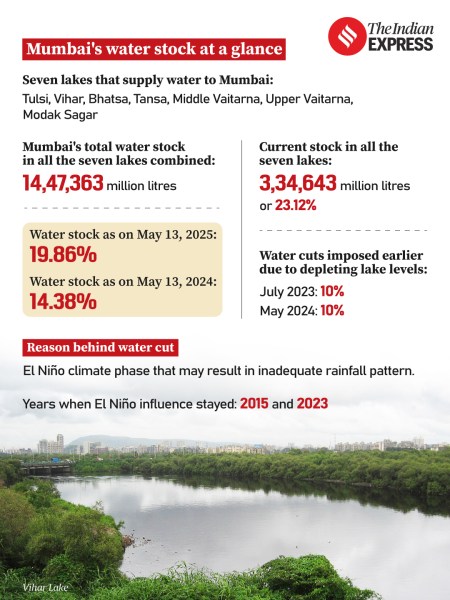 Mumbai’s water stock at a glance. Graphic: Abhishek Mitra
However, the BMC has proposed a water cut this year since the India Meteorological Department (IMD) has projected “below normal” southwest monsoon for 2026, owing to the El Niño weather pattern: a climate phenomenon where sea surface temperatures in the central and eastern Pacific Ocean become unusually warm.
The BMC supplies 3,850 million litres daily (MLD) to Mumbai against an overall demand of 4,300 MLD, leaving a deficit of 450 MLD and according to the officials, Mumbai’s current stock is set to last till early August.
With inadequate rainfall on the cards, civic officials said that if water is supplied in full capacity, then stock will last only till the end of July. During an El Niño phase, the months of June, July, and August usually record much less rainfall, while the overall heat levels increase.
Meanwhile, Mumbai and its adjoining districts have been continuously recording day temperatures around 35-40℃ over the last three months. Between March and April, Mumbai also recorded four heatwave days. With increasing day temperature, there is also a high chance of faster evaporation of the water stock from the lakes, leading to a rapid depletion of supply: another reason for authorities to impose a cut to ensure adequate supply lasts till August.
“Usually, the lakes start to get replenished by the end of June and reach their full capacity by August. However, during an El Niño phase, rainfall usually picks up a little late, starting around the months of July and August,” an official told The Indian Express.
Meanwhile, owing to the receding lake levels, the civic body has been imposing water cuts consistently for the past few years. In July 2023, the BMC had imposed a 10% cut after the lake levels fell below 10% due to inadequate rainfall. The same year, BMC had approached the state government asking for an additional quota of water from state control reserves, citing emergencies.
Later, in May 2024, a 10% cut was again imposed after the water levels in the lake fell below 10%.
BMC’s contingency to reduce dependency
To ensure an uninterrupted water supply for Mumbai and to reduce its dependency on monsoon, especially during an era of climate change, the BMC has chalked out plans to construct two desalination plants at Mumbai’s Manori and Versova. Each of these plants will have a capacity to treat 200 MLD of water, to be later raised to 400 MLD.
A desalination plant is a facility that treats saline seawater by purifying it to make it fit for potable usage. Several international coastal cities like Tel Aviv (Israel) and Dubai (the United Arab Emirates) depend heavily on desalination plants. Even in Chennai, two desalination plants are currently operational at Minjur and Nemmeli, while a third plant at Perur is expected to begin operation by September 2026.
