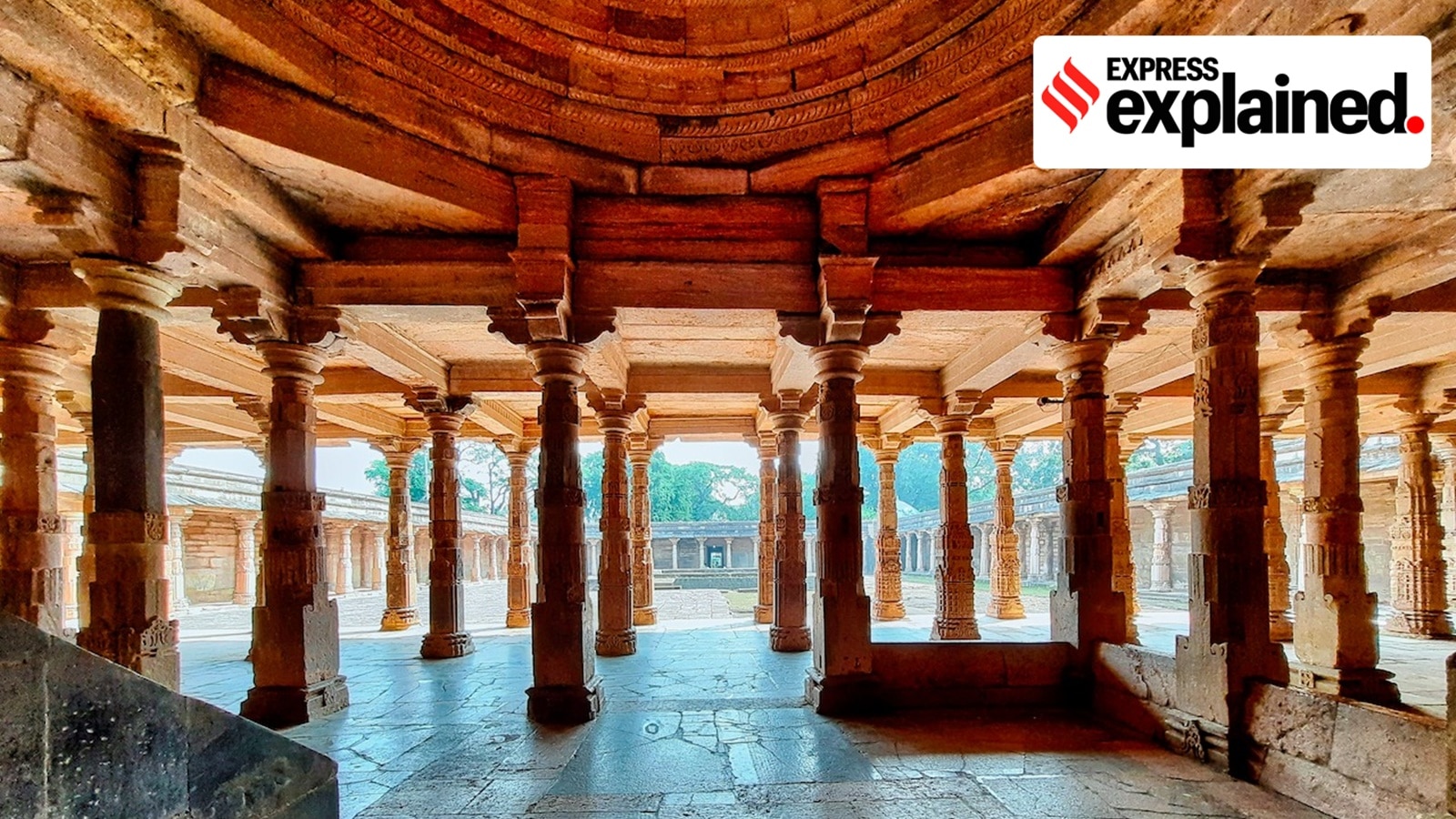
 Hindus regard the ASI-protected complex as a temple dedicated to Goddess Vagdevi (Saraswati), while Muslims consider it the site of the Kamal Maula mosque. Wikimedia Commons
The Bhojshala-Kamal Maula Mosque complex in Madhya Pradesh’s Dhar has long been the subject of competing claims, with Hindu and Muslim groups asserting religious rights over the medieval structure. Last year, the Madhya Pradesh High Court ordered a (ASI) survey by the Archeological Survey of India to examine the nature and historical features of the site.
Hindus regard the ASI-protected complex as a temple dedicated to Goddess Vagdevi (Saraswati), while Muslims consider it the site of the Kamal Maula mosque. Under an arrangement made in 2003, Hindus perform puja at the complex on Tuesdays while Muslims offer namaz on Fridays.

On Friday, the High Court concluded that the religious character of the disputed Bhojshala-Kamal Maula Mosque complex was that of a temple of Goddess Vagdevi Saraswati. Here’s a look at what both sides argued in court.
The Muslim side’s argument
The lawyers representing petitioners from the Muslim side had cast doubts over the fairness of the ASI report, the defects in the ASI survey, and the lack of evidence over the destruction of a Saraswati temple.
Referring to the historical record, senior advocate Salman Khurshid had argued there was no direct evidence that a Bhojshala temple had been demolished to construct the Kamal Maula mosque. “There is nothing in the record of the survey report… where there is any direct specific evidence or an assertion that this… is a property where a Bhojshala temple existed which was demolished and in its place the Kamal Maula mosque has been constructed,” he submitted.
Khurshid also alleged irregularities in the handling of artefacts recovered during the survey. Referring to a sealed room within the complex that had been under the collector’s control since 1997, he claimed objects recovered there appeared suspiciously clean. “When archaeological things are retrieved from the ground, there’s a lot of soil attached to those archaeological artefacts… but here they’ve come out clean virtually,” he argued, adding that plastic bottles were also allegedly found underneath, raising doubts about the authenticity of the recovery process.
Questioning omissions in the survey process, Khurshid repeatedly pointed to the absence of carbon dating. “Carbon dating could have solved many problems, but carbon dating has not been done,” he said, referring particularly to the basalt stone foundation and other disputed structural features.
He also argued that the ASI had altered portions of the mosque structure during the survey itself. According to him, existing stairs and platforms within the premises were removed despite judicial directions to preserve the monument’s character. “The ASI in its process of the survey ended up destroying… stairs and steps, etc, which have been virtually removed and destroyed,” he submitted.
Khurshid relied on the 1904 gazette notification declaring the site a protected monument to argue that the ASI was legally bound to preserve the monument in the form in which it was originally protected. “The 1958 Act merely says that you have to preserve the character, and no desecration can take place. It does not say that you go and find the character and change the character accordingly,” he argued, alleging that Section 16 of the law had been “completely wrongly read”.
He also said inscriptions and recovered idols cited in the ASI report were not conclusive proof of a temple. Referring to Saraswati idols found at the site, Khurshid argued that these could equally indicate a place of learning. “In all educational centres and learning centres, the idol of Saraswati is kept there as a symbolic gesture,” he said.
The Hindu side’s argument
Advocate Vishnu Shankar Jain, who appeared on behalf of the Hindu side, sought direction that “only members of the Hindu community have the fundamental right under Article 25 of the Constitution of India to perform puja and rituals… within the premises of Saraswati Sadan, commonly known as Bhojshala.”
Jain also prayed that “members of the Muslim community have no right to use any portion of the appropriate property for any other religious purpose”.
He submitted to the court that the “true nature of the premise in question is of a Saraswati temple…” He then proceeded to share photographs of the contested site, including inscriptions, which he claimed were of Sanskrit and Pali origin, pillars of an ancient Hindu temple, a mandap of a temple and the image of a deity.
What the High Court ruled
The court said historical literature and architectural references established that the disputed complex was associated with Raja Bhoj of the Parmar dynasty and functioned as a centre of Sanskrit learning.
Allowing petitions filed by the Hindu Front for Justice and others, the court on Friday set aside portions of the April 7, 2003, order passed by the ASI director that restricted the rights of Hindus to worship within the Bhojshala complex while permitting namaz by the Muslim community.
It also directed the Union government and the ASI to take decisions regarding the administration and management of Bhojshala and the Sanskrit learning centre situated on the disputed land in Dhar district, while clarifying that the ASI would continue to exercise overall control and management of the protected monument under the 1958 Act.
