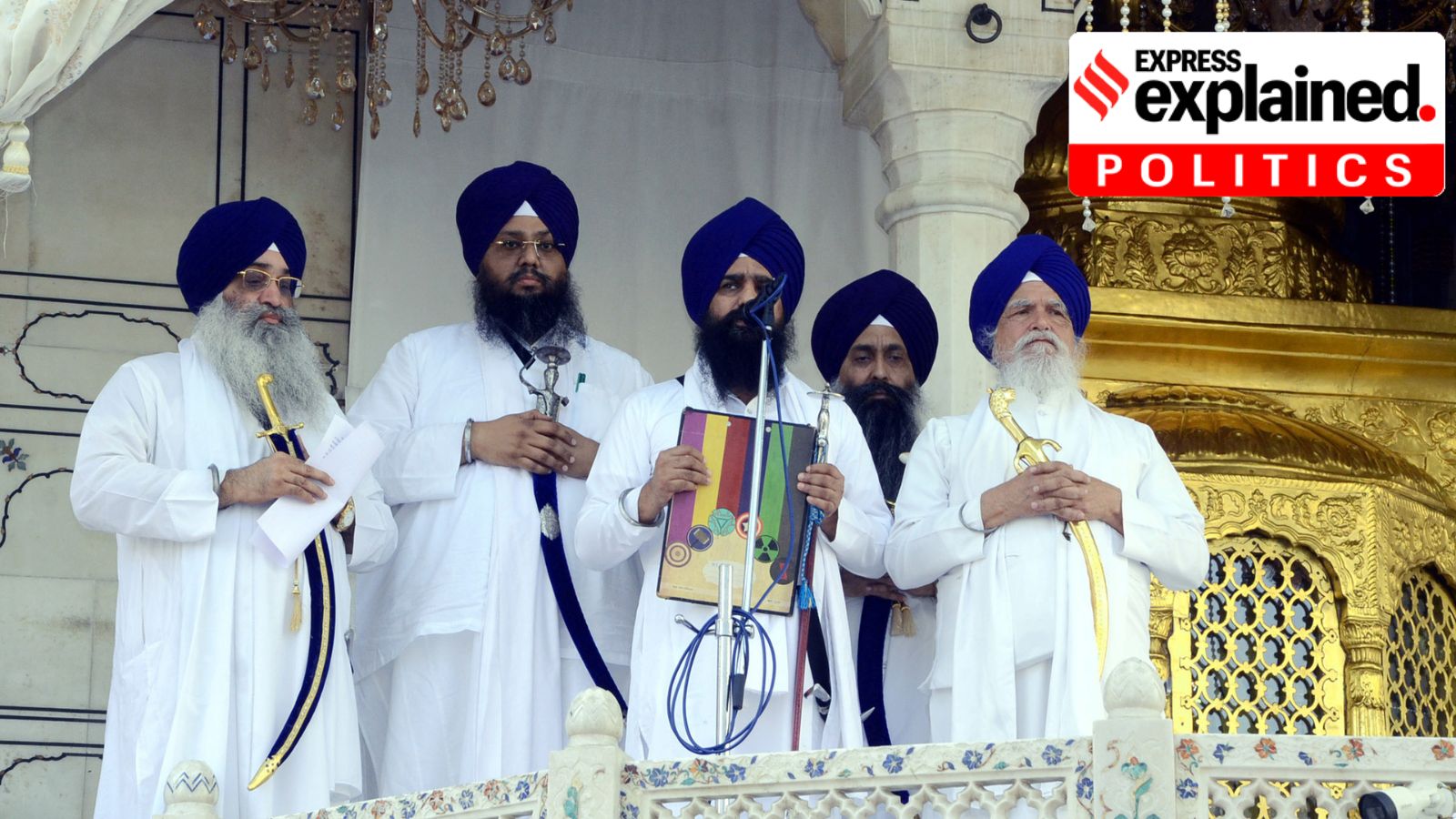
 The five Sikh high priests pronouncing the religious verdict against Punjab CM Bhagwant Mann from the Akal Takht in the Golden Temple complex in Amritsar on June 15, 2026. (Express/Rana Simranjit Singh)
The Akal Takht issued a summons last week to all Sikh legislators and cabinet ministers of Punjab to explain their support of an anti-sacrilege law without properly consulting with it, the Shiromani Gurdwara Parbandhak Committee (SGPC) or other ‘panthic’ bodies.
The Jagat Jyot Sri Guru Granth Sahib Satkar (Amendment) Act, 2026, passed on April 29, has been criticised for expanding the definition of sacrilege to include “hurt sentiments” and prescribing draconian jail terms. The legislators have been asked to appear before it on June 29.

The Takht’s summons to the 78 Sikh MLAs and nine Sikh Cabinet ministers comes two weeks after it declared Chief Minister Bhagwant Mann “panth virodhi” (opposed to the panth), and issued an edict calling for his boycott over an objectionable video.
Few institutions have shaped Sikh religious and political life as profoundly as the Akal Takht. Here is a look at what the Akal Takht is, how its authority evolved, and why its summons continues to carry weight.
What is Akal Takht?
The Akal Takht, meaning “throne of the timeless one”, is the highest temporal (worldly/political) seat of the Sikhs. It’s located directly opposite the Golden Temple (Harmandir Sahib) in Amritsar.
It was founded by Guru Hargobind, the sixth Guru, between 1606 and 1609, shortly after the execution of his father, Guru Arjan Dev, by the Mughals. Guru Hargobind deliberately built it on a raised platform higher than typical Mughal thrones as a symbol of defiance and sovereignty. He wore two swords: miri (worldly power) and piri (spiritual authority), signifying that worldly affairs must be guided by spiritual consciousness.
The Jathedar (head) of the Akal Takht is widely regarded as the highest temporal religious authority in Sikhism. The Jathedar can summon any Sikh, regardless of rank or position, and issue edicts (hukamnamas).
While this authority is not backed by the police or courts, it enjoys deep moral and traditional acceptance within the Sikh community. Over the centuries, kings and elected chief ministers have submitted themselves to its edicts, often a public reprimand for straying from the panthic principles.
What role did it play in Punjab before 1947?
Before Independence, the Akal Takht was the political and decision-making heart of the Sikh community during turbulent times. It was here that Guru Hargobind issued the first directive for Sikhs to arm themselves and resist Mughal oppression.
In the 18th century, during the Misl period, it became the venue for the Sarbat Khalsa, community gatherings, often convened on occasions such as Diwali and Vaisakhi, where resolutions on resisting Mughal and Afghan invaders or other administrative matters were passed.
Even Maharaja Ranjit Singh, the most powerful Sikh ruler who presided over a largely secular empire, subjected himself to the edicts of the Akal Takht. The then Jathedar, Akali Phula Singh (a Nihang warrior), summoned him over his marriage to Moran, a Muslim dancer, and Ranjit Singh appeared and accepted the punishment.
The British tried to control the shrines by appointing loyalist sarbrahs (managers), but the Gurdwara Reform Movement of the 1920s wrested control, leading to the formation of the SGPC in 1925.
What role has it played in Punjab politics since 1947?
The Takht has frequently exercised its religious and moral authority over secular politics. It played a central role in the Punjabi Suba movement of the 1950s and 1960s, when the Panj Pyaras at the Akal Takht censured both Master Tara Singh and Sant Fateh Singh for breaking their pledges during fasts unto death.
It was from the Takht that the Akalis formally launched the Save Democracy Morcha (Democracy Bachao Morcha) in July 1975 during the Emergency, with daily voluntary arrests after offering ardas and receiving saropas. More than 40,000 Akali volunteers courted arrest during the 19-month campaign.
During the militancy years, Jarnail Singh Bhindranwale operated from the Akal Takht complex, lending his movement symbolic legitimacy, though he was never its official Jathedar.
The Takht has summoned political leaders across party lines. It took action against President Giani Zail Singh, chief minister Surjit Singh Barnala (for police action in the Golden Temple complex during Operation Black Thunder), and Union Minister Buta Singh (for the government-funded reconstruction of the Akal Takht). All three eventually appeared and performed the assigned atonement.
In 2024, it declared SAD president Sukhbir Singh Badal a tankhaiya, or guilty of religious misconduct, over the handling of sacrilege incidents and other decisions during the SAD-BJP government (2007–17), including matters related to Dera Sacha Sauda. It ordered a public apology and sewa (service), and also revoked the “Panth Rattan Fakhr-e-Quam” title of his father, five-time chief minister Parkash Singh Badal.
What kind of ‘punishment’ does it dole out?
The Akal Takht does not impose legal fines or jail terms. Instead, it declares individuals tankhaiya and assigns tankhah (atonement) through sewa such as cleaning shoes, utensils or toilets at the Golden Temple, often while wearing a placard of repentance and making a public apology.
The Takht can also order excommunication (as it did with chief minister Barnala in 1987), impose a social or religious boycott, and revoke titles and honours. These are moral and social sanctions, but they can be politically devastating in Punjab.
Has the Akal Takht Jathedar ever faced blowback?
Yes. The Jathedar is appointed by the SGPC executive committee and can also be removed by it. Bhai Ranjit Singh, who served as Jathedar from 1996 to 1999, was suspended by the SGPC executive in February 1999 amid the political feud between then CM Parkash Singh Badal and SGPC chief Gurcharan Singh Tohra. More recently, Giani Harpreet Singh and Giani Raghbir Singh have faced similar fates, often after issuing edicts affecting SAD leaders and criticising the SGPC.
After issuing a pardon to Dera Sacha Sauda chief Gurmeet Ram Rahim for dressing up as Guru Gobind Singh, the Akal Takht was forced to revoke this decision in 2015 following outrage from the community.
What are the perils of ignoring a summons?
Ignoring a summons is seen as defiance of the Takht’s moral authority. When Barnala, who was chief minister from 1985 to 1987, defied its directives relating to Operation Black Thunder, he was declared tankhaiya and excommunicated. His government subsequently collapsed, leading to President’s Rule. He later performed public atonement.
The Takht’s authority remains deeply embedded in the Sikh psyche. While some view it with cynicism because of perceived politicisation through the SGPC, many Sikhs regard it as the essential guardian of maryada (the panthic code of conduct) and an important check on politicians. Political leaders usually conclude that submitting to the Takht’s directives, even reluctantly, carries fewer political costs than defying them.
