 A US gasoline pump. Gasoline prices have spiked in the US amid the Iran war. AP
As the conflict in West Asia continues to strangle fuel and fertiliser supplies across the world, pushing up prices and the cost of living, a familiar question has resurfaced: Who gets hurt the most?
Whether one talks about individuals or families or whole economies, the short answer is that there is a stark difference between how such a crisis affects the haves and the have-nots.

In other words, often such crises create a K-shaped economy. This is a phenomenon where the economic divisions and inequalities widen with one (often small) segment of the economy tending to consume heavily while another (often large) segment struggles to even consume the staples.
A K-shaped economy
The war in Iran is already beginning to reveal a K-shaped pattern. Economists at the Federal Reserve Bank of New York recently analysed the way US consumers spent on fuel as pump prices started increasing.
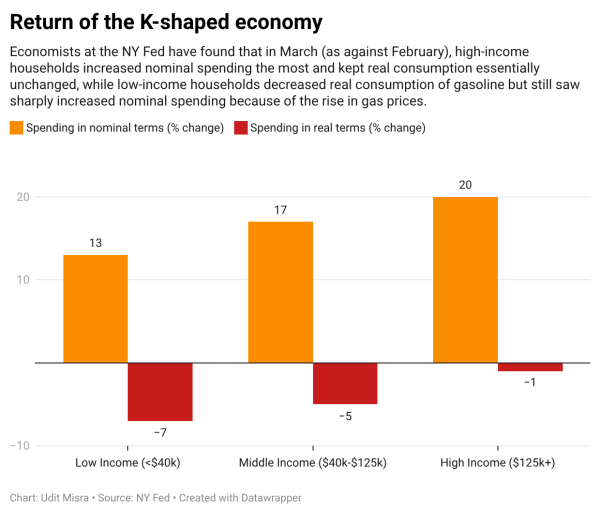
They found the following: “In March, high-income households increased nominal spending the most and kept real consumption essentially unchanged, while low-income households decreased real consumption of gasoline but still saw sharply increased nominal spending because of the rise in gas prices.”
 K-shaped economy
The chart alongside shows what happened to consumer consumption in March, compared to February. The poorest — US consumers earning less than $40,000 a year — spent 13.33% more on fuel prices but this “nominal” increase in spending does not capture the “real” decline of almost 7% in spending. In other words, while the poorest spent 13% more money to buy fuel, they ended up buying 7% less actual fuel.
The middle-income earners — those earning between $40,000 to $125,000 a year — spent 17% more on fuel but managed to buy 5% less actual fuel.
The richest consumers managed to increase their spending by over 20% and thus ensured that their actual consumption of fuel barely changed.
Why this research matters
These research results are based on a sample of 2,00,000 consumers over just one month but still they reveal something familiar.
“These divergences in the response to an energy price shock are not unique to the month. Four years ago, energy prices rose and remained elevated during the spring and summer of 2022 when the Russia-Ukraine war disrupted energy markets. The magnitude of the initial Russia-Ukraine gasoline price shock was broadly similar to the current one, but it lasted longer to date and ramped up over time,” say the authors, led by Rajashri Chakrabarti.
The broader point is: As oil prices stay elevated, the poor will struggle to consume the same amount even after spending more while the rich will spend more to maintain the same level of real consumption.
Only looking at nominal spending patterns hides the deepening economic divide that happens during such crises.
This economic divide was best captured by the following quote (often attributed to poet Damian Barr) that became popular during the Covid-induced economic recession in 2020: “We are all in the same storm but not in the same boat”.
Richer consumers in any country (and by the same logic, richer countries, say, Japan or South Korea) will be able to spend more in order to take a smaller hit on their actual consumption while the poor (and poorer countries such as Bangladesh or India) may end up being forced to consume less even if they spend more.
