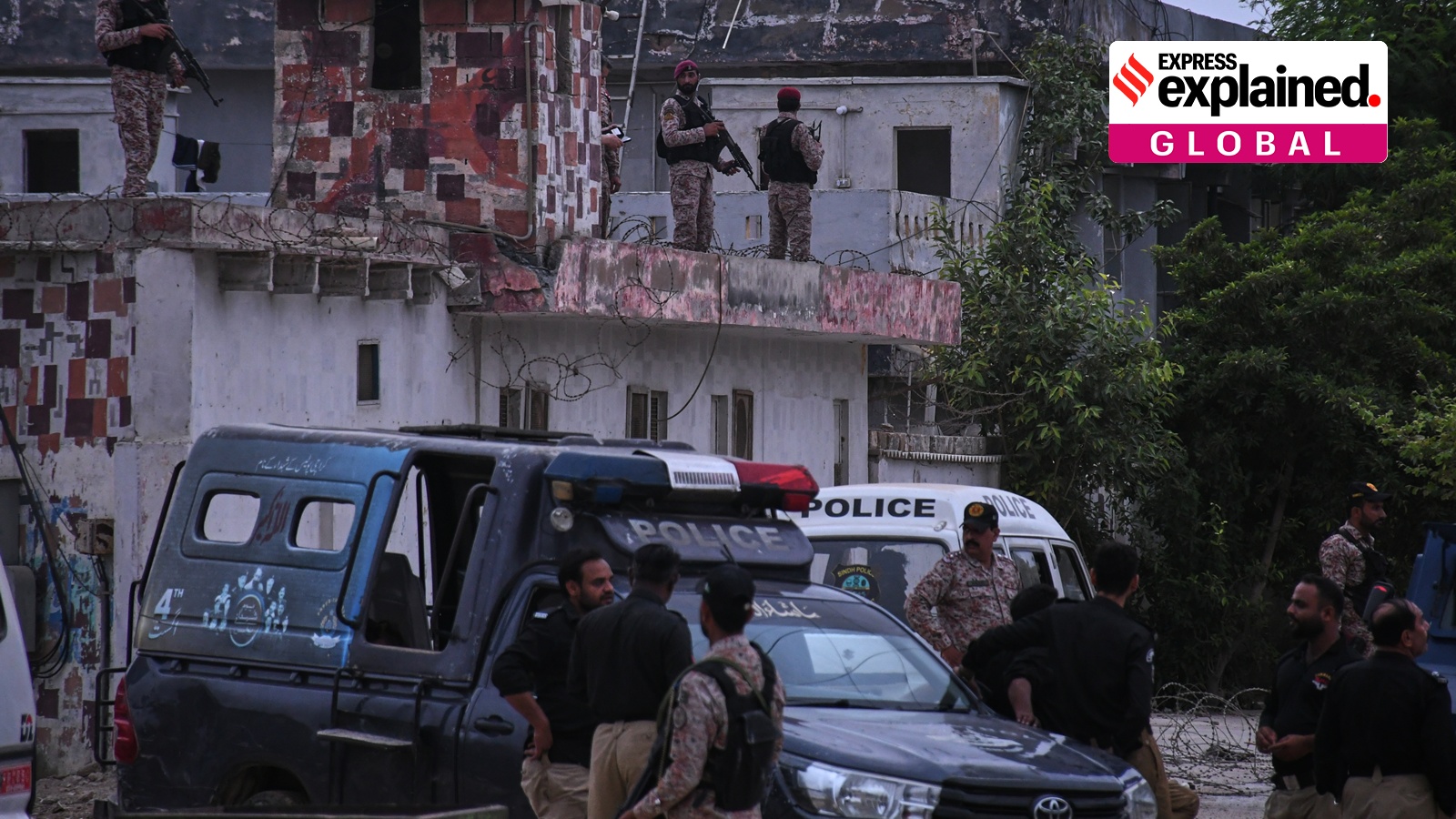
 Paramilitary soldiers examine a damaged area after a militant attack at the provincial headquarters of the paramilitary Pakistan Rangers in Karachi, Pakistan, Sunday, June 28. (AP Photo)
About two weeks ago, Pakistan was singled out for praise by Washington, Tehran, and many other capitals for its peacemaking efforts culminating in the US-Iran MoU. On June 29, it bombed parts of Afghanistan and killed around 30 people.
Pakistan has blamed India for using “proxies” to spread terror in the country, but developments from the last week alone capture its many unresolved domestic fault lines: insurgency and terrorism, the weaponisation of blasphemy allegations, and state repression.

The Karachi attack, one of many
Pakistan’s bombing of the Afghan provinces of Paktia, Paktika and Kunar came after a Rangers’ facility in Karachi was attacked on June 27. Militants detonated an explosive and opened fire on the compound, killing three paramilitary personnel and three of the attackers.
Militant attacks on Pakistani territory have been rising, with the TTP and the Baloch Liberation Army (BLA) behind most. The think tank Pakistan Institute for Conflict and Security Studies (PICSS) compiles weekly reports of violence in the country. Its latest report, from June 20, gives an idea of the scale. “During the week under review (12–18 June), militant violence intensified across Pakistan, with the number of attacks increasing by 32 percent from 19 during the previous week to 25. The attacks resulted in 27 deaths and 69 injuries.”
The Karachi attack shows that even fortified urban centres are not immune to the violence. Pakistani authorities have said the assault was carried out by Jamaat-ul-Ahrar, a faction associated with the Tehrik-e-Taliban Pakistan (TTP) or the Pakistan Taliban.
According to the United Nations Security Council, “JuA was formed in August 2014… Most of JuA commanders and operatives hail from Mohmand Agency of the Federally Administrated Tribal Area, Pakistan.” It is based in Afghanistan’s Nangarhar. While the TTP and the JuA have fallen out and come together more than once, Pakistan alleges that both are supported by India. After such allegations were repeated post the Karachi attack, the Ministry of External Affairs issued a statement dismissing them.
Pakistan has also been claiming that India’s recent warming-up to the Taliban regime is with an eye on destabilising Pakistan, and that New Delhi’s ‘embrace’ of the Taliban is helping ‘legitimise it internationally’.
The June 29 bombings are one in a long series of strikes it has carried out across the border, as its once-strong ally the Taliban refuses to act against the TTP. The TTP opposes the Pakistani state for not being Islamic enough and for helping the US in the war against terror. It operates from Afghani soil, and though the Taliban government claims it does not support the TTP, it doesn’t crack down on it either. For Pakistan, which had hoped to act as the Taliban government’s big brother, this is a big blow.
Just before the US-Iran war broke out, Pakistan had declared an “all-out war” on Afghanistan, and the two were exchanging fire. Now, peace talks are being mediated by China, termed the Urumqi Process, but have clearly not made much headway. However, routinely bombing a tough neighbour with seemingly infinite capacity to take pain is hardly a sustainable strategy.
“The only realistic policy for Pakistan towards Afghanistan is to accept it as a truly independent and sovereign state free to determine its course of events as well as foreign policy choices. As long as Pakistan believes that its security interests demand that it intervene in Afghan affairs, there will never be normal ties between Rawalpindi and Kabul. Strangely, Pakistan, which is quintessentially a Punjab-dominated state, has always failed to understand the Afghans, even though it has a large Pashtun population on account of the Durand Line,” Vivek Katju, India’s former ambassador to Afghanistan, told The Indian Express.
Sentencing of Mahrang Baloch
If the TTP has capitalised on Pashtun grievances against the Pakistani state, a more disaffected population is that of the Baloch, who have long sought to secede from Pakistan over unfair treatment and exploitation of the province’s natural resources. While the BLA has waged the struggle violently, the State has also cracked down on lawful protesters.
Last week, rights activist Mahrang Baloch was sentenced to life imprisonment by an anti-terrorism court. Mahrang is the chief organiser of the Baloch Yakjehti Committee. She along with another activist, Sibghatullah, were found guilty of inciting the murder of a paramilitary soldier in Gwadar in 2024. Rights groups have condemned the proceedings, arguing that the trial raises serious concerns about due process and freedom of dissent.
Mahrang Baloch is one of the most prominent voices highlighting the issue of enforced disappearances and alleged human rights abuses in Balochistan. Her father was picked up by security forces and found dead two years later. After her brother was also similarly detained and released after months, Mahrang became the face of the movement against forced disappearances. While activists say security forces have picked up thousands of people who were later found dead or not at all, the State claims such people have either fled abroad or joined the militancy.
“There is an active war going on in Balochistan, resulting in state repression that includes killing and abductions. The State has routinely been accused of abducting those fighting for the Baloch nationalist cause,” analyst Ayesha Siddiqa, Senior fellow at King’s College, London, who hails from Pakistan, told The Indian Express.
Geo News ban
The third controversy centres around Geo News, one of Pakistan’s largest television networks. The channel was taken off air for two weeks after allegedly blasphemous content was aired during a programme on Muharram, even though Geo News promptly apologised.
The blasphemy law has long been used to silence dissenters and progressives in Pakistan, and the ban on a popular TV channel shows the chilling power the blasphemy discourse commands in the society.
